One Great Cruise!!!

One Great Cruise!!!
Life is Good

Welcome Friends!!!

We hope you find this blog enjoyable as you share our trip "around the world". We are, by far, some of the luckiest people on earth to be able to do this.

Friday, March 26, 2010

Guam: Where America's Day Begins

GUAM--Thursday, March 25, 2010

Guam is an unincorporated territory of the USA making it where America's day begins (about 14 hours before it does on the East Coast of the United States). We began the day early by lining up for the mandatory immigration inspection at 7 a.m. Unfortunately, the doors did not open until 7:30 p.m. so we experienced hurry up and wait.

We took the Hagatna Highlights tour to the capital city of Guam. Our tour guide, Jun, short for Junior, told us that the island experiences a very pleasant climate with high temperatures of 88 degrees and low temperatures of 76 degrees, two seasons--dry and wet--with the best months to visit being December to March, high humidity and about 40 inches of rain a year. The topography reminded us of Florida with its beautiful coastal views of the ocean, the highest point being about 300 feet above sea level and well paved highways. About one-third of the land on the islands is used by the military. Much construction is happening on Guam because the Marines are transferring their forces there from Okinawa.

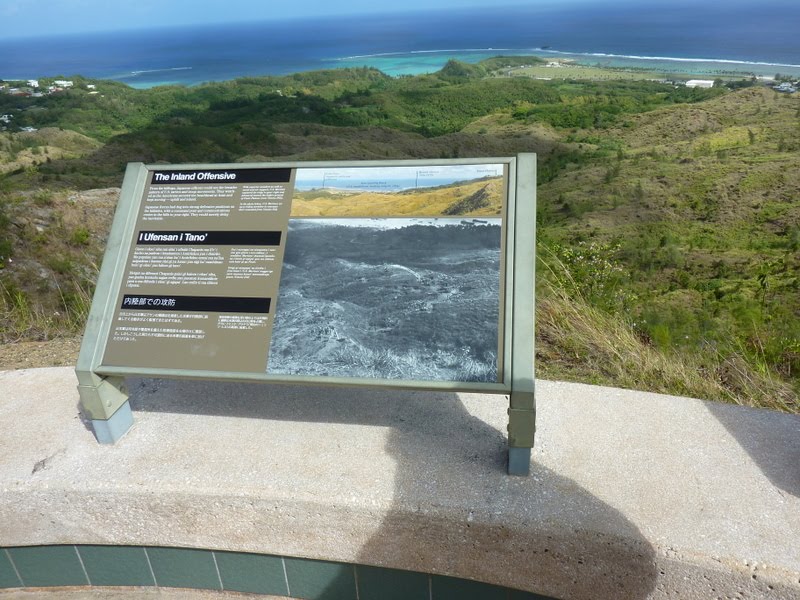
Our first stop was the Asan Bay Overlook and the War in the Pacific National Historical Park. The Japanese attacked Guam on December 8, 1941. Facing the bay is a monument to the first Chamorro US military casualties who died in the attack on Pearl Harbor. A wall lists all the citizens of Guam who endured rationing, force labor, beatings and execution by the Japanese. Unfortunately, 34 of the 99 bronze plaques with their names were stolen in 2007 and sold for scrap metal. The replacement glass plaques of black with white lettering are easier to read than the original bronze plaques. On July 21, 1944, 55,00 American troops landed. The Marine captured the ridge and secured the Orote Peninsula,liberating Guam.

We stopped at Fort Santa Agueda and passed the Guam "White House" or the governor's mansion. Our next stop was Latte Stone Memorial Park with 139 latte stones, which are pillar/post arrangements. The round tasa stone on top is the capstone while the shaft stone is the post. They are a symbol of Charmorro culture that may have been used for burial grounds. On the back side of the park is a Japanese cave, part of an interconnected and extensive system that the Japanese used for storage and bomb shelters.

At the Plaza de Espana, which is now used for many government and civic activities, we viewed the circular Chocolate House in which the governor's wife served hot chocolate, and later tea, to the governor's guests, and the Summer House, which is still a social meeting place. In the plaza is a monument to the Guam Insular Force Guard who valiantly defended the town on December 10, 1941, against a far superior force. In the middle of the road is a statue of John Paul II, the first pope to visit Guam. The citizens had a parade for him on that street, and the monument was built on the spot where the pope knelt down to kiss the ground.

On our way to the other side of the War in the Pacific National Historical Park, Jun told us that Guam Beer in cans is made in Korea and that Guam holds the distinction of drinking more Budweiser beer per capita than any other place in the world. Also, spam is the most consumed food and the manufacturers have produced a special Guam-only spam with tabasco sauce and garlic. Guam has no mass transit system so the ratio of cars to citizens is almost 1:1.

At the national park, we saw where the marines came ashore. Sara also talked with a minister who recently moved to Guam, after being stationed there in the 1970s, to be the associate pastor of the Church of God on the military base to prepare for the military influx.

We were somewhat disappointed with our tour as where others who went on different tours. Even our tour guide said he was disappointed because our tour was only three hours, and he much preferred the six-hour tours. After our exotic ports of call, Guam seemed too Americanized.

When we arrived back at the ship, we took the free Princess shuttle past the world's largest K-mart and into downtown. There we saw the famous Guam Slingshot ride with six Gs of acceleration and the upscale stores. More than 80 percent of the tourists are from Japan.

When we arrived back at the ship, the Pacific Princess hosted the Chamorro cultural dancers. Now we know how America's day begins and come to an early end with the Guam version of the Electric Slide. Janie, our new friend and follower, was out there dancing to the beat with a young Chamorro man and doing great. After the last dance, the young people greeted everyone in the audience with a kiss on both cheeks and a hug. Then they gave a traditional blessing so that we would reach our next destination safely. Guam's all-purpose greeting word is Hafa Dai. Hafa Dai!

Thursday, March 25, 2010

Rabaul and Chuuk: The Good, The Bad and The Ugly

SOMEWHERE BETWEEN CHUUK AND GUAM: Wednesday, March 24, 2010

There is no denying that the ports of Rabaul and Chuuk were the poorest and dirtiest we have visited but also were the most fascinating. Frankie, our deputy cruise director, offered a discussion session for passengers to comment on the good, the bad and the ugly of these two ports. We have divided the comments from our fellow passengers into three categories: general comments on both ports, comments on Rabaul and comments on Chuuk.

GENERAL COMMENTS
1. Both places had poverty but many of us did not notice it.
2. One passenger commented that "they were just a couple of Hell holes so why did the ship stop?" Many of the people present started to boo. One women stated that while there is poverty and they don't live the way that we do, they do not need a lot to live. Yes, it is cultural shock when a person is not used to it. Then the captain came on the P.A. system saying that, "This is the bridge. This is for exercise only. Man overboard." Frankie commented that he hoped it wasn't the man who made the comment about the Hell holes, because he was not sure anyone would rescue him.
3. Frankie asked us not to wear our flashy, shiny jewelry in the ports in poor countries because we were only looking for trouble. (Sara did not bring any flashy, expensive jewelry except her wedding, engagement and anniversary rings.)
4. To look at the people and to talk with them is to learn from them. The whole cruise is an education.
5. A passenger who was interested in WWII complimented the ship for showing films about the battles.
6. One passenger reminded us that we are ambassadors for the USA. We should treat the people like we would like to be treated (the Golden Rule). The more we talk to them, the more we will learn and the more we will benefit. In fact, he got a beer for one dollar at the local bar.
7. Rabaul has an Australian influence while Chuuk has an American influence, even in the supermarkets.
8. One passenger said that this information would have been so much more valuable if we had it before arriving in Rabaul and Chuuk. Frankie said that the Pacific Princess had no organized tours on Chuuk because the tourism business is still developing. But wasn't it refreshing that these islands were not prepackaged?
9. Frankie asked why the islands were poor. Some answers were the government, need for good leadership, corruption, not on tourist routes, living off the land, and those that became educated moved to more affluent countries, which continued the cycle of poverty.

RABUAL
1. In Rabaul, some passengers encountered a truck load of girsl who were there for hospitality purposes to learn from us to enhance tourism in Papua New Guinea.
2. One passenger suggested carrying a hand full of coins to stick on the forehead and then give to the native children. Frankie commented that the next group of tourists that watched the children rubbing the coins and sticking them on their foreheads would claim that it was an ancient tradition carried on by the children in Rabaul.
3. Bob, our table mate from Williamsburg, Virginia, went to the cemetery in Rabaul and was impressed by how well the grounds were kept.
4. Mary thought that it was her duty to try local foods in places that are new to her. She tried the beetlenuts in a supermarket. The natives told to spit but never swallow. Once her jaw was numb and she was sweating profusely, a person gave her the mustard and lime mixture that allows the psychoactive ingredient to be absorbed into the cheek. Mary had the orange tongue and photograph of it to prove it. Janie, who has been everywhere, even on land in Antarctica, related that her taxi driver was a medical student who claimed he chewed bettlenuts so that his teeth would be stronger. A native of India stated that Indians chew bettlenuts but now scientists are finding that the nuts may be a cause of cancer.
5. Frankie told us that Rabaul was the cleanest that he had ever seen it. The wind was blowing in the opposite direction, and the volcano had actually stopped smoking, a first.

CHUUK
1. A passenger was distressed by his entrance into the Blue Lagoon where he saw poverty and rusted cars. His taxi drive said that there was no employment and that the people live off the local fruits and vegetables, such as bread fruit.
2. One of the locals told a passenger that typhoons start in Micronesia and then head west.
3. Several passengers were surprised to find the shelves well stocked.
4. Frankie and Chuck agreed that the whole soul of Chuuk was the children who sang in the church. Chuck said that Austin, a small boy, was fascinated by Frankie but then who wasn't?
5. One woman got a $5 haircut when she was in Chuuk two years ago on the 2008 World Cruise and replied that her hair was just now growing out.
6. The math teacher who won the Sudoku challenge said he had been invited into the youth center, where they were teaching about the spread of AIDS. Australians were providing the money for this education.
7. On woman felt two soft taps on her back. When she turned around, she saw two little girls who put their heads down and smiled shyly. She asked to take their picture.
8. The signs in Chuuk are in Filopino, not Japanese. However, the older residents speak a form of Japanese because the island was occupied by the Japanese during WWII. But this language has been so corrupted that today's Japanese people cannot understand it.
9. In one yard was a half-buried, rusted-out car with flowers sticking out of it and gravestones in the back.
10. There had been a funeral in Chuuk that day in which the deceased was taken home to his island in a boat to be buried, and the mourners went in other boats to help bury his coffin.
11. Passengers could mail packages back to the USA at the Post Office at US rates. However, the post office did not have packing tape so one couple went to a store where the owners helped them wrap their package. Part of the UGLY of Chuuk was the American passengers pushing to get ahead in the post office. Unfortunately, we did not mail anything back because the post office had only medium packing boxes by the time we went there in the afternoon after our exciting adventure.
12. The choirs had no CDs of their music for sale. One passenger is being sent a copy of the arrival and sailaway music for free. He promised he would let us know when it arrived, probably in a decade or so.
13. Chuuk grows some of the best bananas in the world.
14. A sign in the supermarket in Chuuk stated "No chewing or spitting bettlenuts."
15. Sara related the story of our tour in Chuuk and Jerry and Ken's excellent adventure of climbing the hill to see the big gun.

16. This is a long story about the ship's environmental officer's experience in Chuuk but it deserves to be told. It is ironic that we are relating this story while the feature story on Headline News is about the riots in Philadelphia.

John, the environmental officer for the Pacific Princess, went for a walk in Chuuk. He turned left when the road forked at the huge mud puddle and walked to a church when he decided that there was not much more to see and started back. He noticed what seemed to be a college on his left when he sensed movement behind him. Three or four young men wearing blue bandanas (the Crips) ran in front of him. When he looked behind him, he saw a larger group of young men wearing red bandanas (the Bloods). One of that group threw a boulder that started coming toward John. Fortunately, it fell and bounced several times on the ground. Then one of boys in the front group made a face and gave the finger to those in the back group. Next he took out a catapult (known to us in America as a slingshot) and started to load it.

A woman, who was a lecturer at the college, beckoned to John to come in through the gate, which she had the security guard shut after John entered. The students in the school ran toward the gate to watch the action while the security guard called the police who apprehended as many of the gang members as they could. The lecturer told John that these incidents were happening quite frequently. When she thought it was safe, she opened the gate, and John returned to the market that had been set up near our ship. There he related his story to the ship's doctor who told John that he had listened to a paper presented by a surgeon about the weapons used in the slingshots. If this type of ammunition hit the victim's heart, it could kill him.

Later that day a passenger who was not feeling well had to be taken to the hospital and was accompanied by the ship's doctor. There the doctor told the story of the environment officer to a doctor at the hospital who was from the Philipines. That doctor told our doctor that he was the person who had made the presentation at the conference. The ammunition used is a small, steel spear with barbs on the tip. The hospital doctor gave a spear that been extracted from the heart of a young man who had been murdered two or three weeks ago to the ship's doctor. This is such a common occurrence that the police do not even keep the spears as evidence any more. The environmental officer passed around the spear that the doctor had sealed in a plastic bag.

The environmental officer thought how ironic this incident was. He had been a policeman for 30 years and could have been taken out on a sunny day in Chuuk while minding his own business because he was at the wrong place at the wrong time.

It really is a small world, in many good, bad and ugly ways!

Tuesday, March 23, 2010

Surprising Chuuk

CHUUK, MICRONESIA--Tuesday, March 23, 2010

BEFORE Impressions
At 11 a.m. on Tuesday, we will dock in Chuuk, a destination that it seems no one on the ship has explored. When Sara was researching all our ports before we started this trip in January, the only thing she found about Chuuk was an article on the Chuuk Lagoon's Ghost Fleet, about the WWII Operation Hailstorm attack by the American Task Force that resulted in wrecks of 60 Japanese ships making this port the standard by which all other wreck dives are measured.

Noemi (correct spelling), of Sergio and Noemi from Cruise Critic, read to us from the Lonely Planet Tourbook (one of our favorites) that there are very few tours in Chuuk but who would want to take a tour anyway because there is nothing to see. For Martyn, our port talk speaker, Chuuk is the only destination on this segment of the cruise that he has never been but he promised to do research for us. Basically, the most important things he learned are that the English is the major language, the citizens use the American dollar, most of the funding for the island comes from the USA, the main business is the Chuuk Coconut Processing Plant, to see the Sapuk Lighthouse you need to contact the owner, Chuuk lovesticks that are used for courtship are good souvenirs, and if you take a jeep to Jeep Island, do not pay until you return. The Pacific Princess had no scheduled tours for this port. If there was something to see on this island, we were sure that the ship would have organized a tour. So today will be a surprise for all. With more than 600 passengers and hundreds of crew members roaming the island, this may be a surprise for the residents of Chuuk also.

AFTER Impressions
We were able to depart the ship at about 11:15 a.m. with the reminder that all passengers and crew must be back on board by 4:15 p.m., giving us five hours to explore this hot, steamy, dirty island. We were greeted by locals who had set up a market and representatives from the visitors' bureau with suggestions for tours and tickets for the Pacific Princess bus to the Blue Lagoon Resort. We were approached by Milton who offered us a tour of the island for $40.00 each, promising that we would be back before the ship left, so we teamed up with Sylvia and Jerry from Napa, California.

The first concern was when our taxi turned out to be a motor boat with no life jackets but a cut- off bleach bottle that we could use to bail out water. Our second concern was when we stopped at another island to gas up and watched the native children pour the gasoline through a funnel into the container. Our third concern was when the boat's seat for three (Jerry sat on a crate in the back) jumped up when we went over a wave because it was not nailed down completely. This may be more of an experience than what we bargained to have!

We traveled from the Chuuk Lagoon on Weno Island to Eten Island, which the ship's literature stated was carved by backbreaking hand labor into the shape of a huge aircraft carrier, and features impressive war ruins. We walked along a crude dirt path and through grass to the wreck of a Japanese plane. School children who had just completed their school day followed us during our entire tour of the island. Then we crawled over a bunker where a woman who lived in the nearby house offered us coconut milk. We then toured the bombed out communication center made of steel reinforced concrete that must have taken a direct hit to look like that. Our guide then told us that we each owed the woman who had the plane on her land a dollar and the man whose land included the communication center two dollars each. The old man came up the path with a walking stick to collect his money.

Milton then said we could take a five-minute walk to see a big gun so we started off over a jungle trail with plenty of exposed tree roots. After we had walked for more than five minutes, the path (that's a joke) went straight up a steep hill. Sylvia and Sara decided to go back to the boat but became disoriented in the jungle. Fortunately, a young man with a machete showed them the way back. Most of the way, this handsome local hunk was accompanied by two beautiful native girls so he did not seem to mind being an impromptu tour guide. Jerry and Ken climbed to the top of the hill to see the gun.

While waiting at the rustic dock, Sylvia and Sara developed a plan for turning this island into a tourist destination. Sylvia had been a travel agent for one year while Sara has taught speech, writing and customer service courses at colleges. They decided to teach the natives and their older children how to be tour guides while Jerry and Ken supervised the locals on clearing off the paths for the tours. When the men finally returned one-half hour later, their legs, shorts, shirts and arms were covered with mud but their faces sported big smiles. Ken said that the trail on the trip back was so slippery and steep that they slid part-way down the hill on their rear ends. Their shorts proved that statement.

Our next stop was another island where we were greeted by a young girl who put leis around our necks and young men carrying roosters. We were entertained by a troop of young boys wearing grass skirts who performed a warrior routine with sticks. Sara asked them the name of their dance but all they did was smile and giggle. When she inquired if they spoke English, they did the same thing. She now wants to teach English in Micronesia as part of the tourism program. The natives set up an impromptu market for us where we bought love sticks and items made with reeds and shells at very good prices.

Our fourth concern was when we boarded the boat for our return trip and the engine stalled several times. We had no idea how we would get to Guam if we missed the ship! Fortunately, we made it back safely.

When we arrived at the ship's dock, Jerry and Ken boarded the ship to have a beer to toast their excellent adventure. Sylvia and Sara decided to walk to the post office and then into what they thought would be a downtown with stores. At the post office, they learned that the other passengers had already claimed all the large flat rate boxes. The dirt road to town had been flooded out in parts and was filled with gigantic pot holes. Also, there really were no stores that sold souvenirs so they carefully walked back to the ship, avoiding the puddles and mud, and shopped at the market set up by the natives, buying a wooden turtle and lovesticks.

Noemi and Sergio, who went on a scuba diving tour with a licensed guide to the wreckage where they saw a cargo ship, airplane and ship, affirmed that the hype concerning the quality of the wreckage dive was not at all exaggerated--it was beyond anything else they have ever seen while scuba diving. On their way down in the water, they saw Craig and Lauren, who had encountered their first shark on a dive trip, coming up.

The last paragraph in the literature provided by the Pacific Princess states, "At present, the economic opportunity for the native population is limited, but with education and tourist dollars many hope for a brighter future." We trust that we did our part to improve their economic conditions.

LEGEND of the LOVESTICKS: In the past, an island man would carve his personal notches on the lovestick and let his would-be sweethearts feel it. At night, he would kneel beside the thatched wall opposite where his lady love was sleeping and poke the lovestick through the wall to entangle her hair. With luck, she would wake up without arousing her family. Then she would put her fingers around the stick's notches and identify her admirer.

Sunday, March 21, 2010

Spirit of Volcano Town

RABAUL, PAPUA NEW GUINEA--Sunday, March 21, 2010

Help! We need some new superlative adjectives for our blog. What can one say when visiting a town that's claim to fame is being destroyed by a volcano in 1937, being rebuilt and than having 80 percent of its buildings leveled by another volcano in 1994, and then is the highlight of our trip to date? Unbelievable!

After getting dressed to meet Perla and Joe's tour (Cruise Critic friends), Sara went out on the balcony to wave to the dock works. When she went back in our room, all the mirrors were foggy. The temperature was already in the 90s and the humidity matched it. However, we soon learned it was a beautiful day in the neighborhood. It had rained the previous day so there was no dust from the ash on the roads, the ash from the volcano had stopped falling in December, and the sun was shining.

Rabaul receives only 20 to 25 cruise ships a year. Tourism is a new industry for the island, and we promised our tour company, Paivu Tours, that we would highly recommend it to friends and family who may visit the island in the future. Just remember, that the air-conditioning comfort in the tour vans is provided by opening the window on one side of the van and then opening the window on the other side. Our tour guide Dorothy and driver Mickey told us that Rabaul means "place of mangroves." As we drove away from the dock, we saw the locals setting up a market for us on the ground, which is volcanic ash. No tables were used. We rode over an extremely bumpy dirt road that turned into a paved road and then back to a dirt road. Because it was Sunday, we saw many locals walking to church. The three major religions are Catholic, Seven-Day Adventist and Methodist--an interesting mix. Riding through Rabaul was a step back time with its low-rise buildings with tin roofs.

Participants in Joe and Perla's tour were Perla and Joe, MaryAnn and John, Mary and Ed, Naomi and Sergio, Betty Ann and Harold and yours truly. Our four-hour tour visited the following seven attractions:

1. Japanese Tunnels. After Pearl Harbor, it became apparent that the Japanese would attack Rabaul. In January 1942, the Japanese captured Rabaul and made it the major center of naval and air operations in the South Pacific. The Japanese had the local and Australian prisoners build a network of tunnels connecting their barges throughout the island. The tunnel that we saw was 200 meters from the water and contained the rusted-out remains of five barges. Going back into the tunnel was amazing.

2. Kopopo War Relics Museum. We traveled to the new capital of Kopopo, where the streets are paved, divided roads with sidewalks. It seems as if politicians take care of their own in every country. (Papua New Guinea is part of the British Empire so the country is ruled by Queen Elizabeth but also has a Prime Minister and a Grand Chief.) Ken was in his glory when we reached the museum with all its cannons, guns, other weapons and ammunition of the Japanese. He particularly liked the "naughty but nice" aircraft nose art. The reference manual for the aircraft systems was on aluminum pages to reduce the damage from water, oil and insects. Outside, natives were preparing for a Baining Fire Dance for another tour group. Their costumes were impressive.

3. Rabaul 1942-1945 Memorial and Montevideo Maru Memorial. Behind the impressive memorials is a rusting sign that asks people to "please do not litter"--an interesting juxtaposition. The Japanese ship Montevideo Maru, which was carrying Australian and local prisoners, was torpedoed during WWII with the loss of all lives.

4. Admiral Yamamoto Bunker and New Guinea Social Club. We actually were able to go down in Yamamoto's bunker where he developed his battle strategies and then tour the social club for Australians in Rabaul.

5. Tavurvur Volcano. We drove through the 1994 volcano area in which there was almost no vegetation and only ash. Dorothy explained that this area used to be covered with houses and part of it was the old Rabaul Airport. We stopped on an old runway to take photographs of the still smoking volcano. Definitely, it was like another world experience.

6. Japanese Plane Wreckages. Ken had an up close and personal experience with the two wreckages when he climbed down into the sites while the rest of us took advantage of the local vendors and talent shows. We appreciated the children's choir from Maliput Village (Rabaul's "Children's Tabernacle Choir") singing the national anthem of Papua New Guinea and a tiny dancer dressed like the Baining Fire Dancers. Ken also liked that we could just give money to the children who performed or wore their native costumes rather than waste time buying anything.

SPECIAL STOP. We stopped at the Lutheran Church that is supported by Betty Ann and Harold's church in Alberta, Canada, so Dorothy took take a photograph of them to show their church members. An example of outstanding customer service from Paivu Tours!

7. Rabaul Volcanological Observatory. Before entering the observatory, we overlooked the bay with a view of the Pacific Princess and the remains of ships destroyed by the sunken volcanoes. The station monitors 14 active volcanoes and watches another 23. The Manam Volcano erupts on the average of once every four years. Ed and Mary were impressed that Ritter Island, which is not far from Rabaul, had experienced volcanic activity. In the Recording Room at the observatory, we enjoyed air-conditioned comfort, which was a real treat that Mary Ann and John, who stayed with the van, missed. The recording of all these volcanoes is done in real time.

When we returned to our ship, Mary, Naomi, Sergio and I took advantage of the impromptu local market and photographic opportunities. We admired and bought some of the wood cravings, clothes, woven bags and jewelry. Peg and Pat, if you are reading this blog (and we hope you are), your souvenirs from Rabual are from the exquisite jewelry line, and they will be required wearing when we get together for our reunion in Chicago in June! You will love them!

Who would have thought that a country that needs to monitors volcanic activity 24 hours a day, is covered in gray ash and has ash piled like snow on either sides of its roads, and seems a throwback to earlier times could provide such an incredible tour. If you ever get the chance to visit Papua New Guinea, do not hesitate to sign up for the trip! You'll love it!

Friday, March 19, 2010

It's the tropics, mate!

CAIRNS, Australia--Thursday, March 18, 2010

Cairns was one of our favorite places when we visited Australia four year ago. Unfortunately, our tour into the rainforest was canceled on Wednesday because not enough people had signed up for such a strenuous excursion on an amphibious Army Duck that included a Dreamtime Walk and native dancers. On Wednesday night, the tour to the Great Barrier Reef was canceled because of the weather. We know that we are near a cyclone but we feel sorry for the passengers who wanted to take the cruise to the reef. It is the only thing that astronauts can see from outer space--they really cannot see the Great Wall of China--and visiting this natural wonder is a once in a lifetime experience.

At breakfast, Ken encountered Mary and Ed, from Cruise Critic and the Build a Boat Contest, who suggested that we do something together. The four of us ran into our next door neighbors, Doris and Claude, who are table mates of Mary and Ed, and the six of us took off for the Visitor's Center. There we saw Heidi and Dave, from Las Vegas, who also are Mary and Ed's table mates, and we became one, big, happy family for the day so that we could get the group rate for the Skyrail Rainforest Cable to and the Kuranda Scenic Railway from the rainforest to the village of Kuranda. Our guide Steve told us to take the skyrail first because it was to get much windier later in the day. He also suggested that we take our time between stops in the rainforest so we could explore the flora and the fauna. According to Steve, Kuranda was a hippie-type village in the rain forest where we could shop and then play with the snakes, koalas and kangaroos. At 1:30 p.m., we were to walk to the train station to board the Kuranda Scenic Railway. More than 1,500 workers lost their lives while building the railway, which was started in 1886 to connect the coast to the tablelands.

Of course, everyone knows what happens when you plan. The travel brochure stated that "the aerial gondolas soar over the forest canopy and the Kuranda Range offering views of the mountains, Cairns and the Coral Sea" or that's what they normally do but Thursday was not a normal day. We arrived at the the skyrail station to be told that there were mechanical difficulties, and we should look around the souvenir shop. Then the skyrail staff suggested that we take the skyrail to the first stop because the problems should be resolved within one-half hour. The ride up the mountains above the rain forest was breathtaking. We watched as palm trees gave way to pine trees. At the first stop, the nature guide gave us a tour and introduced us the wait-awhile plant that catches people and doesn't let them go and is used for rattan furniture; the Kairi Pine that grows 50 meters in height, can live 1,000 years, provides valuable timber, and has a smooth trunk that sheds bark to clean itself so nothing can usually grow on it; the basket ferns that are epiphytes that attach themselves to trees but do not harm their hosts; the orchids that flower in August and September; big spiders that build humongous webs; and the Southern Cassowary, the biggest bird in the rain forests that is known as the gardener of the rainforest because it eats fruits and poops seeds.

When we got back to the station, we were sure that the mechanical problem would have been resolved. How gullible were we? The guides kept saying that it would only be 10 more minutes. Heidi befriended a group of young men tourists from Busan, South Korea, where we will be on March 30, and Carl, one of the park employees, assured us that the repairs were almost finished because the repairmen were not working as hard. (Is that really a good sign?) At 12:30 p.m., we finally boarded a gondola to Kuranda. Our visit was limited to window shopping in the stores on the main street. Doris really wanted to have her picture taken with a koala. The gatekeeper at the zoo took pity on them after our experience with mechanical difficulties and let her and Claude sneak into to see the koalas without paying the entrance fee and have their picture taken for only $15.00.

We had to catch the 2 p.m. train because it took an hour and one-half to travel back to Cairns and the ship left before the 4 p.m. train would arrive. The railroad goes over 40 bridges and 15 tunnels, making it one of the most dramatic train rides in the world and Australia's answer to the Orient Express. We think we liked the train ride even more than we enjoyed the gondola ride over the rainforests. At one point, we viewed this amazing waterfall on the left side of the train before going over a bridge. We wondered what happened to the waterfall after we went through a tunnel on the other side of the bridge when the waterfall appeared upclose and personal on the right side of the train. Ken took some great photographs.

The train arrived in downtown Cairns 15 minutes late but no one seemed concerned. It's the tropics, mate! We had time to shop in the downtown area and even got to go to some of the stores in the Night Markets that opened at 4:30 p.m. before getting on our ship for another beautiful sail away.

Everyone we talked with seemed to have a good time in Cairns. Lauren and Craig returned to the ship after their trip to Ayers Rocks. They said it rained every day but they really enjoyed themselves. The Red Center has so had so much rain during Australia's summer that they are now calling it the Green Center.

Tuesday, March 16, 2010

Spectacular Sydney

SYDNEY--Saturday, March 13, 2010, and Sunday, March 14, 2010

Having spent four days in Sydney in March 2006, we wondered if the city would hold the same charm for us as it did then or if we would think, "Been there, done that." Our conclusion is that Sydney is fabulous! Many tour books include itineraries for staying in Sydney for one, three, five or seven days. We will comment on our suggestions for spending a weekend in Sydney if one has already toured the Sydney Opera House, participated in the Sydney Harbour Bridge Walk, strolled through the Royal Botanic Gardens, walked through The Rocks and enjoyed the entertainment at Darling Harbour.

DAY 1: Saturday
Buy a day ticket for the Sydney Explorer Bus with it on and off stops, and recorded and live commentary. Get on the Red Bus at Stop 1 at Circular Quay and marvel at all the sites around the city of Sydney. Especially note Mrs. Macquaries's chair built by one of the early governors of the Sydney Colony for his wife so that she could look at the spectacular views of Sydney Harbour and long for her beloved England; Hyde Park, which is named after its namesake in London; Queen Victoria Building with its beautiful way to shop; Chinatown where thousands celebrate Chinese New Year in February; Sydney Fish Market; the Chinese Gardens; and The Rocks. The entire circuit takes two hours.

Then transfer to the Bondi Explorer or the Blue Bus for another two-hour ride around the outskirts of Sydney for the incredible coastal views. Hop off at Watson's Bay and take the cliff edge walk to the Gap Park to enjoy the great coastal views across to North Head. Get on the bus again and hop off at Bondi Beach, Sydney's most famous beach where the sport of surfing was born. We were fortunate to see our very first surf board contest on the beach where surfing was discovered. A real party atmosphere! Pass the pool at the Iceberg Club where people swim with the ocean as a backdrop. Then follow the coastal path to the beautiful Bronte Beach and hop back on the Bondi Explorer Bus to pass Coogee Beach, the Royal Randwick Racecourse, Cricket Ground and Football Stadium, Oxford Street with it exotic boutiques, Sydney Tower and the Cenotaph, the memorial to all Australians who fought in wars in the United States. End your day shopping at The Rocks Weekend Market that is open from 10 a.m. to 5 p.m. with more than 200 stalls.

Day 2: Sunday
Buy a DayTripper past that allows you to travel all on the trains, buses and ferries. If it is Sunday, try to find a child so you can get the Family Funday pass for only $2.50. A woman offered us one of her sons, 4 and 10, as we were purchasing our tickets but the ticket taker refused to believe either boy was part of our family because he had overheard her generous offer. Take the ferry past Luna Park and get off at Darling Harbour for a trip to the Sydney Aquarium, an aquatic paradise that more than 12,000 marine animals call home. Do not feel bad if you do not see the platypus because we waited more than 10 minutes at the first exhibit and never saw it. Enjoy the penguins, seals, turtles, crocodiles, jellyfish and snakes. Get up close to the manatee's cousins, the dugongs, considered mermaids by the early pirates and sailors, in the Mermaid Lagoon. Walk under water in the Sea Aquarium with sharks and stingrays swimming over you. See Australia's largest Great Barrier Reef exhibit. We do not have much experience with large aquariums, having only been to the Baltimore Harbor Aquarium, but we voted this one the best we have experienced.

Spend several hours in the Australian National Maritime Museum to view Mythic Creatures: Dragons, Unicorns & Mermaids, the life of a 19-year-old New York boy who sailed from New York to Sydney in 1905, the history of water sports in Australia, life in the Royal Australian Army for both men and women, a replica of Captain Cook's ship Endeavor and the HMAS Onslow submarine. Then take the ferry back to Circular Quay and transfer to the Manly ferry for an experience you will never forget. After a 30-minute ferry ride with every other tourist in Sydney and all the families taking advantage of the Family Funday pass, walk from the terminal along The Cosco, the shop-lined pedestrian strip with its own arts and crafts market, to Manly Beach with its golden sands and rolling surf. Before you take the ferry back to Circular Quay, stock up on Australian wines. Now you know how we spent our weekend, how did you spend yours?

THOUGHTS on SYDNEY: Our ship docked at Circular Quay so we enjoyed the picture postcard view of the Sydney Opera House from our balcony. When we ate in the outside dining facility on Deck 9, we had a view of both the opera house and the Sydney Harbour Bridge with all the miniature-looking people climbing to the top. These views at night with the lights were breathtaking. It is a real plus to have two days in one city. While we loved Sydney, we were surprised at how much more expensive items were than when we visited four years ago. It has definitely become a world-class city with all the benefits and drawbacks.

Typical day at sea--NOT

SAILING to SYDNEY--Thursday, March 11, 2010

How do we spend a typical day at sea on a world cruise with 60+ sea days? After we get up and are dressed, we stood in a long line at the Pacific Lounge for the mandatory Australian Inspection (our deck drew the 8 a.m. slot), ate breakfast at the Panorama Buffet,listened to a port lecture on what to do while spending the weekend in Sydney, and had lunch with an Oscar-winning filmmaker (yes, you read that right, and no, this was not a typical day for anyone). Arnold Schwartzman won an Academy Award for his documentary, Genocide, on the Jewish Holocaust. It probably helped that he had his friends Elizabeth Taylor and Orson Wells narrate the film. He is even better known as a designer of the posters and programs used for the Academy Awards. He was a speaker on the ship and was accompanied by his wife, Isolde, who is a member of Cruise Critic so they came to our last luncheon on the second segment of the cruise. She complimented us on our blog, which she had been following, so we sat beside her, not realizing who she or her husband was. He is a very active 74-year-old whose work was forcing them to get off the ship in Sydney and take a taxi directly to the airport to catch a plane to Los Angeles so he could concentrate on his designs for two museums. Both he and his wife were delightful. We compared notes on how much we had enjoyed our port days in New Zealand, how we were disappointed that the direct feed from this year's Academy Awards program did not work on the ship and how they enjoyed visiting his sister and her family in Perth, Australia, the world's most isolated city.

The sad part of the luncheon was saying good-bye to Harvey and Carol, and Amelia. Amelia's husband, Ken (a very good name), was flying from Los Angeles to spend Saturday night with her in Sydney and then fly back to LA with her. What a great guy! Please remember to follow us and comment on our blog whenever you like. Parting is such sweet sorrow.

Now that we were on a first name basis with Arnold and Isolde, we attended the Art Deco Architecture lecture he gave. Art Deco is his passion, and he has written two books on the subject. Even after the lecture, we are not sure that we can describe the style but we saw a lot of beautiful photographs that he had taken around the world of Art Deco gems. Then we took part in the "Oscar" Auction of Oscar Memorabilia designed and donated by Arnold. Ken bid on the program for the 70th Annual Academy Awards. The front cover centers around a wheel with the Oscar-nominated films for Best Picture that year. It was a very good year for Hollywood films--As Good As It Gets, The Full Monty, Good Will Hunting, L.A. Confidential and Titanic, the big winner. We need to decide how we will display this treasure.

Okay, so it isn't every day one goes through immigration to Oz, considers options for touring Sydney or dines with an Academy Award winner and his wife. But a world cruise is full of surprises and adventures. We feel so fortunate that we are having this incredible experience and wish that all of you who are reading this blog will consider it as a possibility in your future. Our port lecturer summed up our experiences by quoting an Old Chinese proverb, "A man who travels 500 miles knows more than a man who reads 500 books." A trip to the destination of your dreams could be worth an entire library!